
Prime Minister Manmohan Singh has called for an urgent need to revamp the entire agriculture extension system in the country through community and private sector participation.

Among the social sector schemes introduced in the Eleventh Plan were the National Rural Employment Guarantee Scheme and Sarva Shiksha Abhiyan. Though the government is also planning to introduce a scheme for food security, it may be the only addition during the current plan.

Buoyancy in the real estate sector along with improved construction activities created jobs and facilitated the return of migrant workers to cities, the Economic Survey for 2022-23 tabled in Parliament on Tuesday said. This assumes significance in view of loss of jobs due to lockdown restrictions imposed in various parts of the country from time to time amid different waves of pandemic since March 2020. The survey points towards sustained recovery in the economic activities during 2022-23 fiscal year.
Business establishments, shops, small factories, transport services and even central government programmes like National Rural Employment Guarantee Act are not functioning due to the strife between the Maoists and security forces. Tribals are unable to enter forests to collect kendu leaves which they sell for a living for fear of being rounded up by security forces.

Ballooning fiscal deficit can derail India's growth momentum
Grain stocks in the current procurement season will be enough to feed all those who go hungry, and the FCI only needs to invest in proper storage facilities.
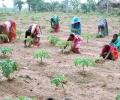
The Centre, last year, had also decided to freeze the minimum wage paid under NREGA at Rs 100. Subsequently, the wages paid in many states under NREGA are lower than the minimum wages in the state.
Launching an attack on the ruling Communist Party of India-Marxist in West Bengal, Congress leader Rahul Gandhi on Monday accused the party of 'grabbing' crores of rupees from central funds meant for the uplift of the poor and downtrodden.
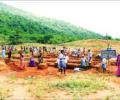
Programme has also failed in its target of providing a guaranteed employment of 100 days in a year to one person per family.
The banks are not ready to open accounts of the beneficiaries through the IT-enabled financial inclusion programme, which is running on a pilot basis in various districts of the state. "The panchayat staff do not co-operate with our business correspondents. They do not come forward to endorse the identity of the beneficiaries. How can we open accounts," asked an official from State Bank of Indore.

A man killed during a recent anti-Naxal operation in Madhya Pradesh's Mandla district was a tribal and not a Maoist, an official said on Saturday. The opposition Congress claimed he was innocent and demanded a high-level probe and a judicial inquiry into the incident.
Although India is a labour-surplus economy with an unlimited number of workers willing to work at a subsistence wage a paradoxical feature of the labour market is the rising incidence of scarcity or shortages amid a situation of potential plenty.
The FMCG sector's demand growth will be powered by effective reduction in the personal taxes and increased allocation under NREGA, though hike in excise duty lead inflation is a cause for concern

A nationwide strike called by central trade unions saw a mixed response across India, impacting various sectors and states differently, with some areas experiencing disruptions while others remained largely unaffected.

Prime Minister Dr Manmohan Singh has called for speedy implementation of various welfare schemes, which target the weaker sections of society.
An activist working for the implementation of the National Rural Employment Guarantee scheme was killed after being mercilessly beaten by a group of 12 Maoists at Jerua village in Latehar district of Jharkhand.
According to the announcement made by chief minister Y S Rajasekhara Reddy yesterday the new wages would be paid to workers under NREGP from May 21 onwards. Reviewing the progress of NREGP works, the chief minister directed district collectors to take up and complete all works under the programme before the onset of monsoons so that funds available could be fully utilised.
Union minister of state for commerce, Jairam Ramesh, said there was no proposal to fix the national minimum wage rate at Rs 60 per day under the National Rural Employment Guarantee Act.
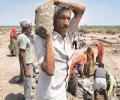
The government's bill for funding the National Rural Employment Guarantee Scheme (NREGS) has risen steeply, due to its decision to revise wage rates under these projects and to link these to the inflation rate.
The forthcoming Budget is likely to make a provision of Rs 64,000 crore (Rs 640 billion) for the Mahatma Gandhi National Rural Employment Guarantee Scheme in 2011-12, against Rs 40,100 crore (Rs 401 billion) in the current fiscal.
Amethi member of Parliament Rahul Gandhi's corporate style of electoral management is causing nightmares to those seeking Congress tickets for the forthcoming Assembly elections in Uttar Pradesh.
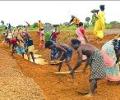
With UPA chairperson Sonia Gandhi pushing for increased wages for labourers, the government on Thursday came out with a new structure for payment of wages under Mahatma Gandhi National Rural Employment Guarantee Act (MGNREGA) that will be linked to inflation.
Since there is no constraint on the availability of central funds for these programmes -- thanks to additional grants, over and above liberal allocations at the start -- tardy implementation by states seems wholly to blame for the lack of progress.
Using banks to make NREGA payments has only added to corruption, says Anirban Kar.
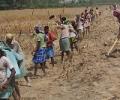
Around 100 NREGA workers, engaged in digging a stretch of land for the past 13 days were paid a paltry Re 1 per day as wages with the district administration justifying the payment saying it was a small area collectively dug by the workers
The latest measure assumes importance as it has come to the notice of the Orissa government that the payment of wages to some NREGS workers is not made within a fortnight. In some districts, the wages are not paid to the workers for months together. It is reportedly causing resentment among people prompting them to abstain from work.
The Nanavati Commission and the IMDT Act were discussed.
Orissa, where the programme was already under a cloud after an NGO alleged false data were being entered on the state's NREGA website, is now uncovering more scams. A team of researchers led by economist Jean Dreze and Ritika Khera, which is doing a survey focussed mainly on the corruption in the programme in Orissa, recently dug out a doctored muster roll in Badhigam gram panchayat of Boudh district.
These villages don't have citizens and hence there is no National Rural Employment Guarantee scheme for them or any health services or cheap rations.
Ramesh, a labourer in Toomda village near Bhopal, can't believe his luck. He earns Rs 81 a day, digging wells under the National Rural Employment Guarantee Programme, the United Progressive Alliance's flagship social welfare scheme that started in 2006.
Higher inflation might just be the necessary cost that we need to bear in making a transition to a higher growth trajectory.
The outlay for the flagship programmes, which -- in addition to the Bharat Nirman scheme -- include the National Rural Employment Guarantee Scheme, Sarva Shiksha Abhiyan and others, is proposed to be raised to Rs 1,23,000 crore (Rs 1,230 billion) during 2009-10 from Rs 90,000 crore last year, representing an increase of about 37 per cent.
In spite of receiving much criticism for his Budget, it has to be acknowledged that FM Chidambaram has pulled the right strings to increase allocations in various schemes. He has effectively curbed govt's spending and has also seen to it that money is not misdirected to wrong pockets. Confronted by political demands, he has responsibly maintained fiscal health and political agendas. He has shown finesse in handling political games and deserves credit for his accomplishments.
"Smart cards are a step towards financial inclusion. The idea is to inculcate banking habits among the poor," says Anita Ramachandra, director, rural development (self-help groups). The government is paying 2 per cent of the amount disbursed through smart cards to the banks to engage them in the initiative.
